
How Search Generative Experience (SGE) is Reshaping SEO in 2026
Search Generative Experience (SGE) is one of the biggest shifts we’ve seen in how Google delivers information. Instead of providing links like traditional search results, users now receive AI-driven summaries that instantly answer questions.
This evolution is redefining online visibility, content strategy, and how businesses can connect with their audiences. In this blog, we’ll explore what SGE is, how it’s transforming search in 2026, and how you can stay ahead.
What is SGE
SGE (Search Generative Experience) is Google’s latest way to enhance search results using generative AI. Instead of showing a list full of links, SGE presents a summarised answer directly on the result page. It combines information from multiple sites, making it easier for users to gain quick, reliable insights without clicking through numerous sites.
Why did Google introduce it?
Google introduced SGE to keep up with current search habits; users now want instant, conversational, and content-rich answers. Google aims to improve user experience, reduce search time, and boost accessibility through AI-powered summaries. For marketers and businesses, it signifies a major shift in how visibility and traffic are generated via search.
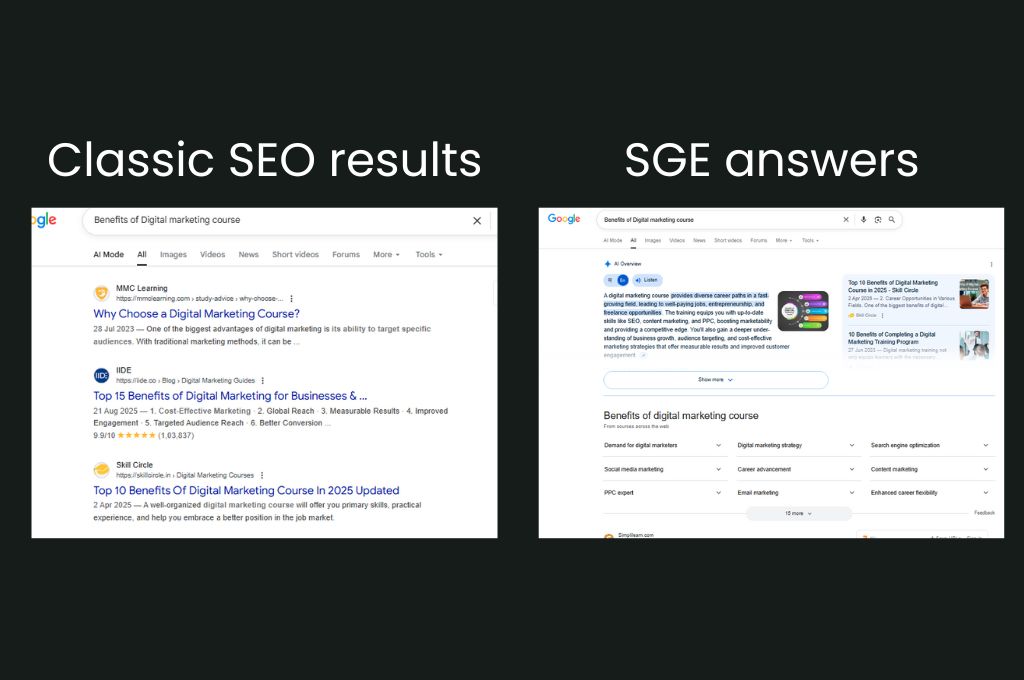
How SGE Is Changing Click Behaviour
The introduction of SGE by Google has fundamentally changed how users interact with search results. Instead of scanning through ten blue links, users now receive AI-generated summaries positioned above traditional organic listings.
- Rise of Zero-Click Searches: Users often get complete answers directly from AI snapshots. Informational queries, such as definitions, comparisons, and basic “how-to” questions, now require fewer clicks.
- Decline in Informational CTR: Top-ranking pages may still appear in results, but attention is absorbed by AI overviews. This reduces click-through rates for broad, educational keywords.
- Increase in Deeper Intent Clicks: Users who do click are more qualified. They move beyond surface-level queries and search with higher intent — case studies, tools, pricing, frameworks, and implementation guides.
- Greater Emphasis on Brand Visibility: Brand exposure increases even without a click when your brand is cited in AI overviews. Visibility is no longer measured only by traffic; it is also measured by mentioned frequency and authority signals.
How does SGE work?
SGE utilises Google’s search index and advanced generative AI models to deliver prompt and context-rich answers. Google’s search algorithm interprets a user’s intent by scanning its index of web pages and using AI when a user enters a query. Then it generates a summarised response that blends information from multiple trusted sources.
The Process is to feel conversational, similar to interacting with a virtual assistant. SGE highlights key points, provides a direct answer, and also includes links to the support website for deeper reading. Instead of browsing through several results, the user can get an overview in seconds, while still having the option to explore if needed.
Google also uses signals like authority, trustworthiness, and relevance when deciding which source to feature in the AI snapshot. This means technology is not only about automation but also about curating reliable information and presenting it in a way that saves users time. In short, SGE functions as a bridge between traditional search and an in-demand, AI-powered, conversational experience.
How to Optimise for SGE: Step-by-Step Framework
The search generative experience encourages content that is structured, precise, and easy to interpret, not just keyword-optimised. To have your pages cited in AI overviews, you must align your content format with how AI systems extract and summarise information. The following framework outlines the essential structural modifications needed to enhance visibility of SGE-driven results.
- Structure content in question-answer blocks: Organise your sections around direct questions that reflect real search behaviour. Immediately follow each question with a concise, clear answer before expanding further. This format makes it easier for AI systems to generate precise summaries. Avoid long introductory fluff before answering the query.
- Use clear subheadings with intent-based phrasing: Write subheadings that are specific, problem-focused, and outcome-driven as users search. Use phrasing that aligns with informational or commercial intent instead of generic titles. When intents are aligned, semantic relevance improves, and AI citation is more likely to occur. Ambiguous headings reduce extractability.
- Add schema markup (FAQ, HowTo, Article): Structured data improves machine readability and contextual clarity. To ensure that search systems interpret your content structure accurately, use FAQs, How-tos, and Article Schemas. Schema may not guarantee visibility, but it can enhance eligibility for enhanced SERP features. Technical clarity is necessary for AI-driven indexing.
- Cite authoritative sources: AI systems prioritise content that is supported by credible references and trustworthy data. Linking to reputable industry studies, research, or official documentation reinforces authority signals. Unsupported claims negatively affect extractability and trust. User confidence and algorithmic credibility are both enhanced by strong citations.
- Include concise summary paragraphs under each heading: Begin each major section with a summary paragraph that directly addresses the topic. Make sure to keep it brief, with a maximum of 2 to 4 sentences before going into a more detailed explanation. By using this layered structure, AI systems can gather quick insights while maintaining depth for human readers. Clarity at the top improves visibility.
SGE vs Traditional SEO
Factor |
Traditional SEO |
SGE-Focused SEO |
| Primary Goal | Rank #1 | Get cited in the AI overview |
| SERP Layout | 10 blue links | AI summary + sources |
| Click Pattern | Higher informational CTR | Fewer but higher-intent clicks |
| Content Style | Keyword-focused articles | Structured, answer-driven content |
| Optimization Focus | Rankings & backlinks | Authority, clarity & extractability |
| Metrics to Track | Traffic & position | Visibility, brand mentions, assisted clicks |
SGE Optimisation Checklist for 2026
Optimising for SGE is not about writing more; it’s about writing sharper. In AI-driven search, clarity, structure, and actionable value are more valued than long theoretical explanations. To ensure your content aligns with how modern search systems evaluate and extract information, use the checklist below.
- Short paragraphs: Make sure your paragraphs are concise and focused on a single idea. Dense blocks of text reduce readability and make extraction harder for AI systems. Both user engagement and machine interpretation are enhanced by short, structured sections.
- Bullet points: Break complex concepts into bullet points wherever possible. Lists improve scannability and clearly highlight key insights. Structured lists are easier for AI systems to parse than long narrative explanations.
- Practical actions: Focus on actionable steps that readers can implement immediately. Replace generic advice with frameworks, checklists, or measurable tactics. AI prioritises content that delivers clear, usable value.
- No theory: Avoid unnecessary background explanations or repetitive definitions. 2026 readers are looking for solutions, not textbook-style discussions. More direct, implementation-focused content performs better in terms of visibility and engagement.
Conclusion
Search Generative Experience is not eliminating SEO; it is redefining how visibility is earned. Ranking alone cannot guarantee traffic or authority, since AI summaries are prioritized on the results page. Businesses must adopt structured, intent-driven, and credibility-focused content instead of keyword-heavy strategies.
The brands that succeed in 2026 will be those that create clear, extractable, and trustworthy information that AI systems can confidently reference. SEO is shifting from position-based competition to visibility and citation-based competition. Early adaptation means staying visible in AI-powered search experiences, where attention now lives.
FAQs (Frequently Asked Questions)
Will SGE reduce organic traffic in 2026?
For broad informational queries, yes. AI summaries reduce the need for clicks. However, high-intent and commercial searches still generate traffic, often with better conversion potential.
Does ranking #1 still matter with AI overviews?
Yes, but not alone. Ranking increases your chance of being cited, yet structured clarity and authority signals now influence visibility just as much.
How can small websites get featured in SGE?
By targeting niche long-tail queries, publishing structured answers, and building topical authority rather than competing on broad head terms.
Is SEO dead because of SGE?
No. SEO is evolving from “rank optimisation” to “visibility optimisation.” The strategy shifts, but the discipline remains.
What metrics should SEO teams track now?
Beyond rankings, track:
- Impressions in AI-influenced SERPs
- Brand search growth
- Assisted conversions
- Engagement depth
0 Comments