
Why Most SEO Campaigns Fail (And How to Fix Them)
Many businesses invest in SEO with high expectations. They expect their website to rank at the top of Google, receive a steady stream of free traffic, and generate a consistent flow of leads or sales. But after months of effort and investment, the results often disappoint. The rankings don’t come, the traffic doesn’t materialize, and the return on investment remains elusive.
If you are searching for:
- Why SEO fails
- SEO mistakes businesses make
- How to fix the SEO campaign
- SEO audit checklist
You’ve come to the right place. This blog explains the real reasons SEO campaigns fail and, more importantly, how to correct them strategically to build a sustainable, revenue-generating machine.
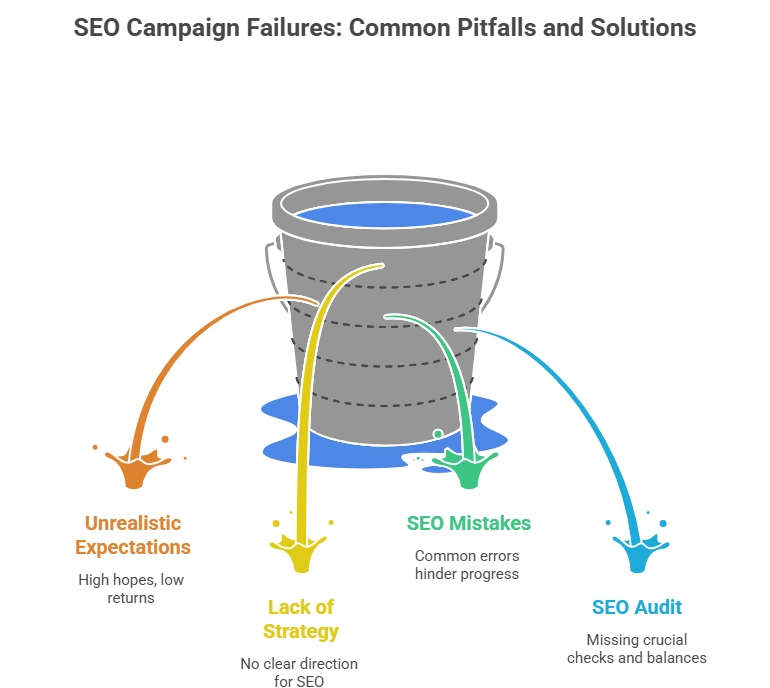
The Reality: SEO Does Not Fail, Strategy Fails
Let’s get one thing straight: Search Engine Optimisation (SEO) remains one of the most powerful and cost-effective digital marketing channels in 2026. It’s not a dying art or a gamble. What fails is not the channel itself, but the approach businesses and agencies take.
Businesses often fall into the trap of doing “SEO activities” rather than executing a cohesive SEO strategy. They:
- Choose the wrong keywords based on gut feeling rather than data.
- Ignore the technical foundation, building content on a broken website.
- Publish random content whenever they have an idea, with no overarching plan.
- Expect instant results, treating SEO like a pay-per-click ad campaign.
- Focus on vanity metrics like traffic instead of real business metrics like conversions and revenue.
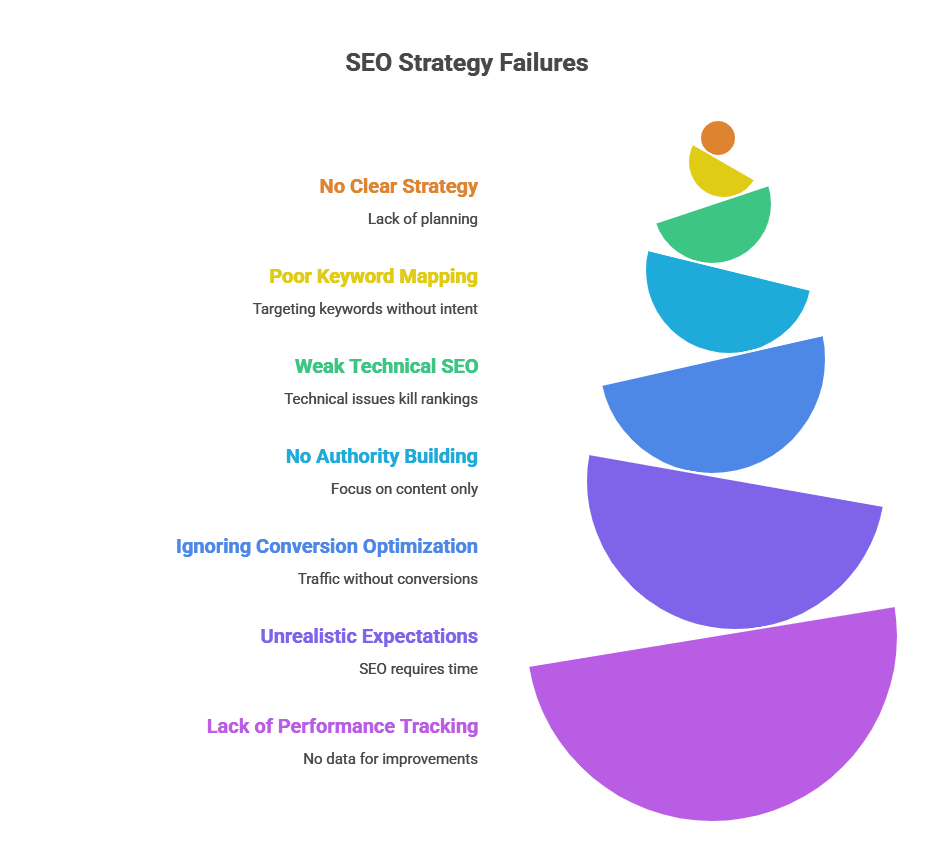
Sustainable, high-performing SEO requires a blend of strategy, technical structure, and relentless consistency. Let’s dive into the seven most common reasons for failure and, crucially, how to fix them.
1. No Clear SEO Strategy
One of the biggest reasons SEO campaigns fail is a lack of a documented, data-driven plan. Many agencies or in-house teams jump straight into tactics:
- Publishing blog posts whenever a topic comes to mind.
- Building backlinks to the homepage from any site that will accept a guest post.
- Optimising meta tags without understanding the user’s journey.
They perform these tasks without first defining the fundamentals:
- Target Audience: Who are we trying to reach? What are their pain points?
- Search Intent: Why is the user searching for this term? Do they want to buy, to learn, or to find a specific website?
- Funnel Stage Keywords: Are we targeting users at the top of the funnel (awareness), middle (consideration), or bottom (decision)?
- Competitive Positioning: Why should a user click on our result instead of the top 10 competitors?
How to Fix It:
Stop treating SEO as a checklist of tasks. Start treating it as a strategic growth function.
- Begin with clear business goals: Are you trying to generate e-commerce sales, book service consultations, or build brand awareness? Your SEO strategy must ladder up to these goals.
- Conduct intent-based keyword mapping: Don’t just list keywords. Map them to specific stages of the buyer’s journey.
- Perform a competitor gap analysis: Identify what your competitors are ranking for that you are not. Analyse their content quality, backlink profile, and technical setup to find opportunities.
- Develop content clusters: Plan your content around “pillar” pages that cover broad topics and “cluster” content that dives into specific subtopics. This builds topical authority.
An SEO campaign must be aligned with revenue goals, not just rankings. Without this alignment, you’re just spinning your wheels.
2. Poor Keyword Mapping
Targeting high-volume keywords without a clear understanding of search intent is a fast track to poor conversion rates. For example, ranking #1 for “what is digital marketing” will bring in a lot of traffic, but very few of those visitors are ready to hire a digital marketing agency. The intent is informational, not commercial.
Common Keyword Mistakes
- Targeting overly competitive keywords: Going after “insurance” or “loans” as a new website is a recipe for disappointment. You’re competing against giants with decades of authority.
- Ignoring long-tail keywords: Longer, more specific phrases (e.g., “best organic dog food for allergies”). They have lower search volume but much higher conversion intent.
- Not separating commercial and informational intent: Treating a “best” keyword (commercial investigation) the same as a “what is” keyword (informational) results in mismatched content and a poor user experience.
- No page-level keyword mapping: Targeting multiple, unrelated primary keywords on a single page confuses search engines and dilutes your relevance.
How to Fix It:
Create structured keyword groups that align with your website’s architecture and the user’s journey. This is often called a keyword map.
- Informational content: Target “what is,” “guide to,” and “how to” keywords. These attract top-of-funnel users and build brand awareness. These should be blog posts or guides.
- Commercial landing pages: Target “best,” “review,” and “vs.” keywords. These help users who are comparing options and are close to a decision. These can be comparison articles or category pages.
- Transactional service pages: Target “buy,” “hire,” “price,” and specific service terms (e.g., “plumber in Austin”). These are for users ready to convert. These are your core product or service pages.
- Local intent pages: Target “near me” or “[service] in [city]” keywords. These capture users with immediate local needs.
Proper keyword architecture ensures you attract the right traffic that is actually ready to engage with your business, improving both rankings and conversions.
3. Weak Technical SEO Foundation
Technical SEO is the bedrock of your entire online presence. If search engines can’t easily crawl, index, and understand your website, even the most brilliant content will remain invisible. Technical issues silently kill rankings.
Common technical SEO problems include:
- Slow website speed: In an era of instant gratification, slow sites punish the user experience and are a confirmed ranking factor.
- Poor Core Web Vitals: These are user-centric metrics for speed, responsiveness, and visual stability. Failing them means a poor user experience and lower rankings.
- Duplicate content: Confuses search engines about which version of a page to index and rank, diluting your link equity.
- Broken internal links: Creates a poor user experience and wastes “link juice” that could help other pages rank.
- Missing canonical tags: Without them, search engines might index multiple versions of the same page (e.g., with and without www), leading to duplicate content issues.
- Crawl budget waste: Search engines allocate a limited amount of time to crawl your site. If they spend it finding errors or low-value pages, your important pages get less attention.
Even the most compelling content cannot rank effectively on a technically weak website. It’s like building a luxury hotel on a foundation of sand.
How to Fix It:
Perform a full technical SEO audit to identify and rectify issues. This should be a regular practice, not a one-time fix.
- Audit site speed and optimise Core Web Vitals: Use tools like Google’s PageSpeed Insights to get concrete recommendations for improvement (image optimization, code minification, server response time).
- Ensure mobile responsiveness: Google uses mobile-first indexing, meaning it primarily uses the mobile version of your site for ranking and indexing. Your site must be flawless on all devices.
- Fix URL structure: Use clean, descriptive URLs that include your target keyword (e.g., yoursite.com/seo-audit-checklist instead of yoursite.com/page1?id=123).
- Resolve indexing issues: Use Google Search Console to see which pages are indexed and identify those with errors. Use noindex tags for low-value pages like thank-you pages or internal search results.
- Implement schema markup: This is a form of microdata that helps search engines understand your content and display rich results (like reviews, FAQs, and event listings), which can dramatically improve click-through rates.
- Strengthen internal linking: Create a logical structure where important pages (cornerstone content) are linked to from many other relevant pages on your site.
A technically sound website provides long-term stability and ensures your content is found and appreciated.
4. No Authority Building
In 2026, Google’s algorithms are more sophisticated than ever. They prioritise expertise, authoritativeness, and trustworthiness, collectively known as EEAT (Experience, Expertise, Authoritativeness, and Trust). Many SEO campaigns focus heavily on content publishing but neglect the crucial work of building authority.
Without a strategy for:
- Quality backlinks: Links from other reputable websites act as “votes of confidence” for your site.
- Brand mentions: Even unlinked mentions of your brand can be a positive signal.
- Industry signals: Being mentioned as a source, having experts write your content, and participating in your industry community.
- EEAT improvement: Showcase your content authors’ credentials and provide clear, accurate information about your business.
Your rankings will always be vulnerable to competitors who invest in authority. Fluctuations in rankings are common for sites with a weak authority profile.
How to Fix It:
Shift your mindset from link building to authority building. It’s a long-term relationship game.
- Develop topical content clusters: As mentioned earlier, creating deep, interlinked content on a specific topic signals to Google that you are an expert in that field.
- Earn high-quality backlinks through digital PR: Create link-worthy assets like original research, data studies, infographics, or expert guides. Then, reach out to journalists, bloggers, and industry publications who would find this resource valuable for their audience.
- Pursue strategic guest posting: Write high-quality articles for reputable websites in your industry. This puts your brand in front of a new audience and earns you a valuable backlink.
- Secure expert-led content: Have your content written or reviewed by a recognised expert in your field. Display author bios that highlight their credentials and experience.
- Build your brand: A strong brand naturally earns more mentions, searches, and links. Engage on social media, participate in industry forums, and provide value wherever your audience hangs out.
Authority building requires consistency and long-term effort, but it is the key to dominating your niche and making your rankings “stick.”
5. Ignoring Conversion Optimisation
Traffic without conversions is just a vanity metric. It’s a wasted investment. Some SEO campaigns generate significant traffic but fail to convert that traffic into leads or sales because they stop at the ranking stage.
The reasons for poor conversion are often found on the landing page itself:
- Landing pages are weak or generic and fail to address the user’s specific query.
- Calls to action (CTAs) are unclear, buried, or non-existent.
- No trust signals are present, such as testimonials, case studies, or security badges.
- The overall user experience is poor due to confusing navigation or distracting elements.
- There is no defined funnel structure; users are dumped on a page with no clear next step.
Your SEO strategy should not stop at getting the click. It must consider what happens after the click.
How to Fix It
Integrate SEO with Conversion Rate Optimisation (CRO) from day one. This is the definition of revenue-driven SEO.
- Align content with intent: Ensure your landing page content perfectly matches the search intent behind the keyword. If someone searches for “buy red running shoes,” your page should display red running shoes for sale, not a blog post about the history of running.
- Conduct landing page testing: A/B-test different headlines, copy, images, and CTA buttons to see which resonate most with your audience.
- Place clear, compelling CTAs: Guide the user towards the desired action. Make your CTAs stand out visually and use persuasive, action-oriented language.
- Incorporate social proof: Build trust by prominently displaying customer testimonials, reviews, case studies, and logos of companies you’ve worked with.
- Optimise for user experience (UX): Ensure your pages are easy to navigate, load quickly, and present information in a scannable, digestible format.
- Set up proper analytics tracking: Before you launch a campaign, ensure you can track form submissions, phone calls, chat interactions, and e-commerce transactions. Know exactly where your traffic is converting (or dropping off).
Revenue-driven SEO, which focuses on high-quality traffic and conversion optimisation, will always outperform a strategy that chases traffic for its own sake.
6. Unrealistic Expectations
This is perhaps the most common killer of SEO campaigns. SEO is not paid advertising. You can’t simply flip a switch and expect traffic to pour in. It requires time, patience, and consistent effort.
Common unrealistic expectations:
- Ranking for highly competitive terms in 30 days.
- Seeing immediate traffic spikes after publishing a single blog post.
- Competing with established, authoritative brands instantly, with little to no backlink profile.
When these expectations aren’t met, businesses often panic, pull the plug, or switch to a new, cheaper agency, undoing any progress they’ve made.
Sustainable SEO takes:
- 3 to 6 months for initial movement: You might start seeing improvements for less competitive keywords, and your technical and content foundation will be set.
- 6 to 12 months for strong, visible results: This is when you can expect to see significant growth in organic traffic and rankings for your core terms.
- Continuous optimisation for the long haul: SEO is not a set-it-and-forget-it project. It requires ongoing content creation, authority building, and adaptation to algorithm updates.
Patience and a commitment to strategic, long-term execution are not just helpful but essential for SEO success.
7. Lack of Performance Tracking
You can’t improve what you don’t measure. Many businesses invest in SEO but fail to properly track its performance. They operate in the dark, unable to distinguish between what’s working and what’s a waste of time.
They ignore the wealth of data available in tools like:
- Google Analytics (GA4): To track traffic sources, user behaviour, and most importantly, conversions.
- Google Search Console (GSC): To see which queries are triggering your site in search results, your click-through rates, and any technical issues Google is encountering.
- Conversion tracking: To know exactly how many leads or sales came from organic search.
- Keyword position trends: To monitor your rankings for target terms over time, not just as a one-off snapshot.
- User behaviour reports: Tools such as heatmaps and session recordings can show you how users actually interact with your pages.
Without this data, your SEO efforts are based on guesswork. You can’t diagnose problems, capitalize on unexpected opportunities, or prove your campaign’s ROI.
How to Fix It:
Become a data-driven SEO operation.
- Set up proper GA4 tracking: Ensure the tracking code is on every page. Configure enhanced measurement events to track scrolls, outbound clicks, and site search.
- Define and track conversion events: In GA4, set up specific goals that matter to your business, such as ‘contact_form_submit’, ‘newsletter_signup’, or ‘purchase’.
- Set up funnels: Track the user journey from landing page to conversion to identify where you are losing potential customers.
- Generate monthly SEO reports: Don’t just report on rankings. Create a comprehensive report that includes organic traffic, conversion data, top-performing content, keyword movements, and technical health metrics.
- Establish performance benchmarks: Use your first month of clean data as a baseline to measure future growth against.
A data-driven SEO strategy enables you to make informed decisions, adapt quickly, and deliver predictable, sustainable growth.
SEO Audit Checklist for Businesses
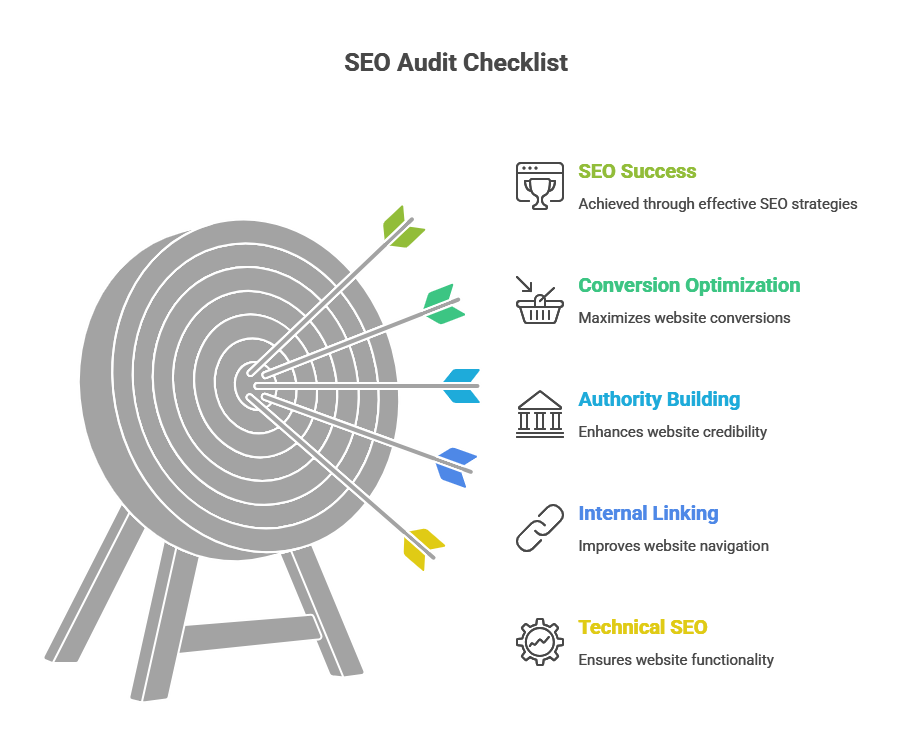
Is your SEO campaign on the right track, or is it heading for failure? Here is a simple SEO audit checklist to evaluate your current strategy. Be honest with yourself.
✔ Clear keyword strategy: Is there a documented plan based on search intent and business goals?
✔ Intent-based content mapping: Does your content strategy match the user journey (informational to transactional)?
✔ Technical SEO health: Is your site free of crawl errors, indexing issues, and duplicate content?
✔ Fast website speed: Does your site load quickly on both desktop and mobile, passing Core Web Vitals?
✔ Mobile optimisation: Is your site fully responsive and easy to use on all devices?
✔ Internal linking structure: Do you have a logical internal linking strategy that passes authority to your most important pages?
✔ Authority-building strategy: Do you have a proactive plan for earning high-quality backlinks and building brand mentions?
✔ Conversion optimisation setup: Are your landing pages designed to convert, with clear CTAs and trust signals?
✔ Analytics and tracking implementation: Is your tracking correctly set up to measure traffic, user behaviour, and conversions?
If multiple points are missing or marked “No,” your SEO campaign is at high risk of failure and needs to be strategically restructured.
Final Thoughts
Most SEO campaigns fail not because SEO is broken, but because the strategy behind them is incomplete or flawed. It’s the difference between “doing SEO” and “having an SEO strategy.”
When SEO is built on a foundation of:
- Technical strength
- Structured, intent-based keyword planning
- Consistent authority signals (EEAT)
- A relentless focus on conversion optimisation
- Meticulous data tracking and analysis
It transforms from a cost center into one of the most powerful, predictable, and profitable growth channels your business can own.
The difference between failed SEO and successful SEO lies not in luck, but in the quality of your planning and the rigor of your execution.
Frequently Asked Questions
1. Why does SEO fail for many businesses?
SEO fails due to a combination of factors, primarily a lack of a cohesive strategy, poor keyword targeting that ignores user intent, a weak technical foundation, a failure to build online authority, and a focus on traffic rather than on conversions and revenue.
2. How long does SEO take to show results?
This largely depends on the competitiveness of your industry and the current state of your website. However, as a general rule, initial improvements for less competitive terms may appear within 3 to 6 months, while strong, sustainable growth for your core business keywords typically takes 6 to 12 months of consistent effort.
3. Can SEO work without backlinks?
For very low-competition, niche topics, it’s possible to achieve basic rankings without a strong backlink profile. However, to compete in any reasonably competitive market and build long-term stability, high-quality backlinks are essential. They are a primary signal of authority and trust to Google.
4. What is the most common SEO mistake?
While many mistakes are common, targeting high-volume keywords without understanding search intent is one of the most costly. This attracts the wrong type of traffic that bounces from your site, signalling to Google that your page isn’t a good result for that query.
5. How do I fix a failing SEO campaign?
The best way to fix a failing campaign is to strategically hit the reset button. Start by conducting a full SEO audit (using the checklist above) to diagnose the root causes. From there, rebuild your keyword and content strategy based on intent, fix the critical technical errors, and ensure your SEO efforts are tightly aligned with your specific, measurable business goals.
0 Comments