
Digital marketing in 2026 is not just a trending field. It is one of the most stable and fastest-growing career paths for students, freshers, and working professionals seeking long-term growth.
As businesses shift online, demand for skilled digital marketers continues to rise. Whether you want to work in an agency, join a company, become a freelancer, or start your own business, digital marketing offers a range of career opportunities.
This complete blog will give you the clarity and direction you need to build a successful career in this dynamic industry.
Why Digital Marketing Is a Strong Career Choice in 2026
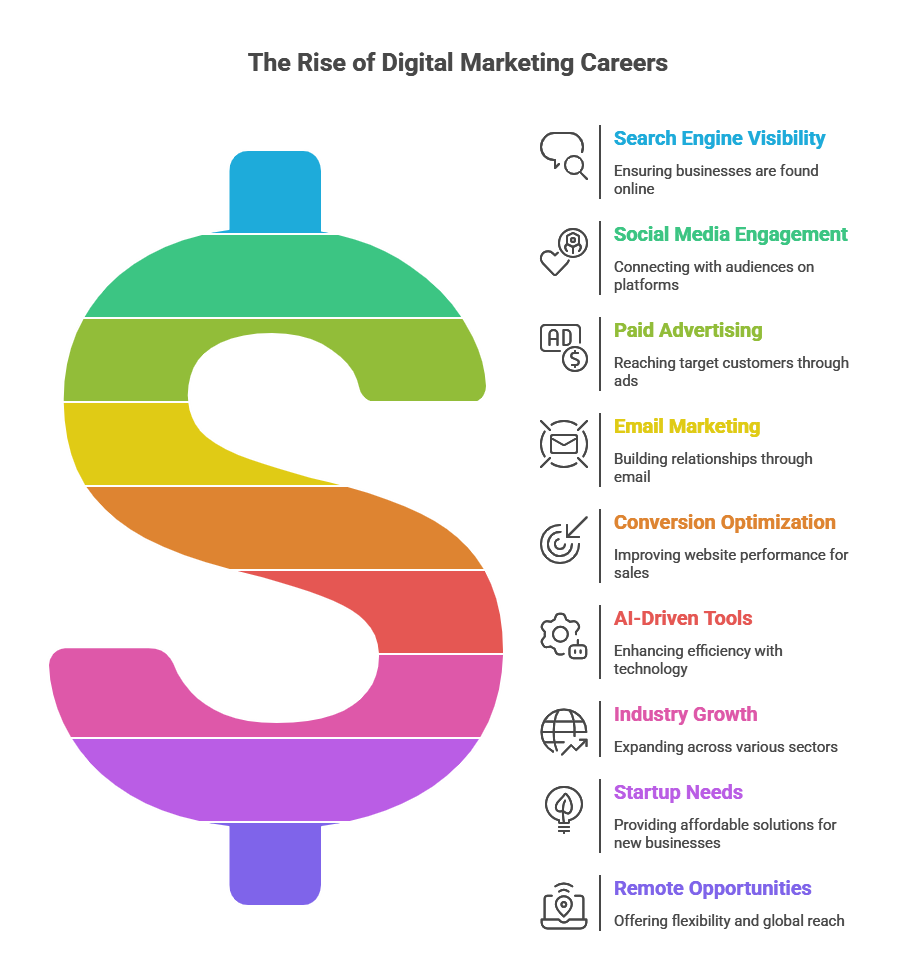
The global economy is becoming more digital every single year. A business’s online presence is no longer just an option; it is the primary driver of revenue and brand reputation. To succeed, businesses today depend on a variety of digital channels and strategies, including:
- Search engine visibility: Ensuring customers can find them on Google and other search engines.
- Social media engagement: Building communities and brand loyalty on platforms like Instagram, LinkedIn, and YouTube.
- Paid advertising: Running targeted ads on Google, Meta (Facebook/Instagram), and other platforms for immediate results.
- Email marketing: Nurturing leads and retaining customers through personalised communication.
- Conversion optimisation: Turning website visitors into paying customers by refining the user experience.
- AI-driven marketing tools: Automating tasks, personalising content, and gaining deeper insights from data.
Every brand, from a local startup to a multinational corporation, wants more leads, more sales, and stronger online visibility. This universal need creates a continuous and growing demand for digital marketing professionals who can deliver these results.
Major Reasons for the Growth of Digital Marketing:
- Every industry is going online: From healthcare and education to real estate and manufacturing, every sector now requires a robust digital strategy.
- Startups and small businesses need affordable marketing solutions: Digital marketing offers cost-effective alternatives to traditional advertising, levelling the playing field for smaller players.
- AI tools are increasing efficiency, but still require skilled professionals: AI can automate tasks, but it cannot create a strategy, understand brand nuance, or build genuine human connections.
- Remote and freelance opportunities are expanding globally: Companies are no longer restricted to hiring talent in their immediate geographic location, opening up a world of opportunities for skilled marketers.
- Digital marketing is not limited to one industry: This versatility means your skills are transferable and valuable across the entire economy, providing immense job security.
Digital marketing is not limited to one industry. Healthcare, education, real estate, e-commerce, finance, travel, and technology all require digital marketing experts.
Impact of AI on Digital Marketing Careers
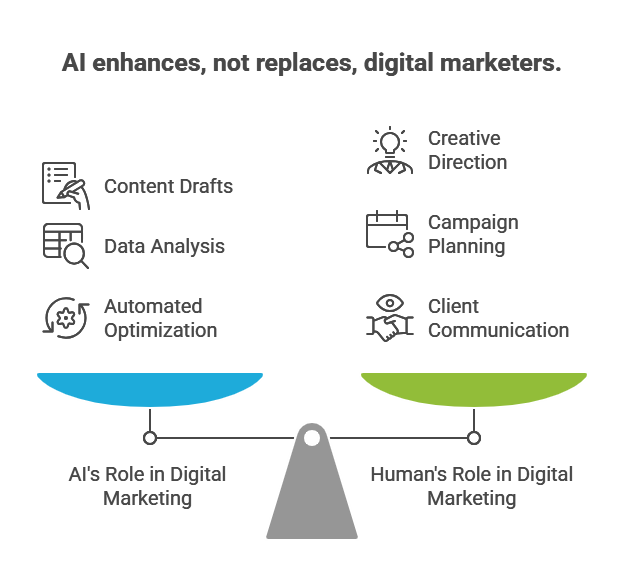
In 2026, one common question is on everyone’s mind: Will AI replace digital marketers? The reality is different and far more optimistic. AI is not here to replace marketers; it’s here to transform how they work, making them more powerful and efficient.
Think of AI as a powerful assistant that handles the heavy lifting, freeing you up to focus on high-level strategy and creativity. Here’s a breakdown of the new division of labour:
What AI Handles (The “How”)
- Generating content drafts (blog posts, social media captions, ad copy)
- Analysing large datasets to uncover trends and audience insights.
- Automating ad bids and optimisation for the best possible return on ad spend.
- Creating performance reports and dashboards.
- Generating keyword suggestions and clustering them for SEO.
What Humans Still Control (The “Why” and “What”)
- Strategy: Defining the overall marketing goals and the plan to achieve them.
- Creative direction: Approving the brand’s visual identity, tone, and the “big idea” behind a campaign.
- Brand voice: Ensuring all communication is authentic and resonates with the target audience on an emotional level.
- Market positioning: Understanding the competitive landscape and finding a unique space for the brand.
- Campaign planning: Orchestrating multi-channel campaigns that tell a cohesive story.
- Client communication: Building relationships, managing expectations, and providing strategic counsel.
The professionals who will thrive in 2026 are those who combine core marketing knowledge with the ability to leverage AI tools. Learning how to use AI for SEO, content marketing, and paid ads is no longer a “nice-to-have”. It’s a competitive advantage that will accelerate your career growth.
Digital Marketing Skills Roadmap for 2026
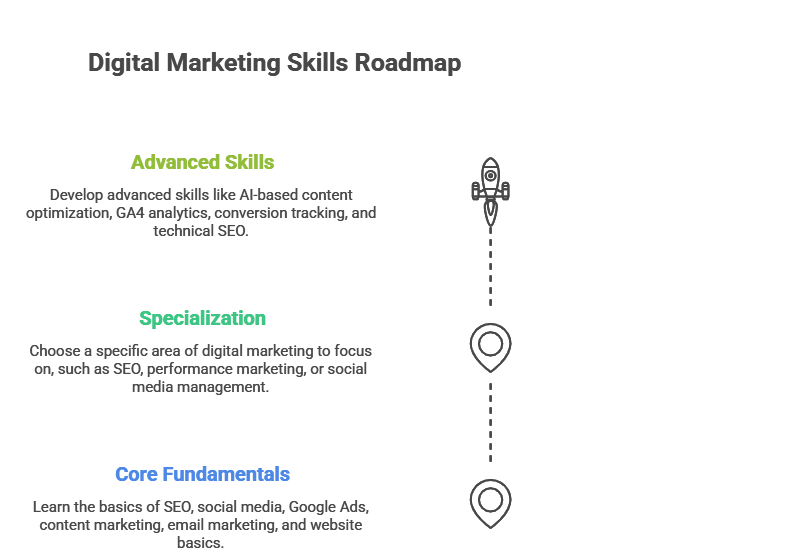
If you are starting from zero or looking to upskill, follow this structured roadmap to build a successful career.
Step 1: Learn the Core Fundamentals
Your journey begins with a solid foundation. Before you can specialise, you must understand how the different pieces of the digital marketing puzzle fit together. Start with the basics:
- Search Engine Optimisation (SEO): How to optimise content to rank higher in search engines.
- Social Media Marketing: How to build a brand presence and engage with communities on social platforms.
- Google Ads and Meta Ads: The fundamentals of running paid advertising campaigns.
- Content Marketing: Creating valuable content (blogs, videos, ebooks) to attract and retain a target audience.
- Email Marketing: Building email lists and crafting effective nurture sequences.
- Website basics and landing pages: Understanding how a website functions and what makes a landing page effective at converting visitors.
Understanding how search engines rank websites and how customers behave online is the foundation for all other skills.
Step 2: Choose a Specialisation
After grasping the fundamentals, it’s time to dive deeper and select a specialisation that aligns with your interests and natural strengths. In 2026, companies prefer skilled specialists who can deliver measurable results over generalists who know a little about everything.
Popular roles in 2026 include:
- SEO Specialist: Focuses on organic search growth, technical website health, and link building.
- Performance Marketing Expert: Mastered paid ad platforms to drive traffic, leads, and sales with a strong focus on ROI.
- Social Media Manager: Builds and nurtures online communities, creates engaging content, and manages a brand’s social presence.
- Content Strategist: Plans, creates, and manages content that aligns with business goals and user needs.
- Marketing Analyst: Interprets complex data from various channels to provide actionable insights and improve campaign performance.
- Conversion Rate Optimisation (CRO) Specialist: Focuses on improving the user experience to increase the percentage of website visitors who take a desired action.
Step 3: Learn Advanced and Practical Skills
To increase your salary potential and stand out from the competition, you must move beyond theory and master advanced, in-demand skills. These are the skills that directly impact a company’s bottom line.
- AI-based content optimisation: Using AI tools to create and optimise content that ranks and converts.
- GA4 analytics and reporting: Becoming an expert in Google Analytics 4 to track user behaviour and measure campaign success accurately.
- Conversion tracking: Setting up and troubleshooting pixel tracking to ensure accurate data for ad campaigns.
- Funnel building: Designing marketing funnels that guide a customer from awareness to purchase.
- Technical SEO basics: Understanding site speed, mobile-friendliness, and structured data.
- Local SEO strategies: Optimising for “near me” searches and Google Business Profile for local businesses.
- Performance Max campaigns: Mastering Google’s AI-powered campaign type to maximise reach across all its channels.
- Ad optimisation strategies: A/B testing ad creatives, audiences, and bids to continuously improve performance.
Hands-on training is crucial at this stage. Watching tutorials is not enough. You need to apply these skills in real-world scenarios.
At KYICS, you are trained not only in traditional digital marketing skills but also in practical AI tools used in real campaigns. Students work on real-time projects and campaign simulations to prepare for industry requirements.
Digital Marketing Salary in India in 2026
Salary in digital marketing depends heavily on your skill level, practical experience, and chosen specialisation. High-demand specialisations like performance marketing and data analytics often command a premium.
Average Salary Range in India for 2026:
- Fresher: ₹2.5 to ₹4.5 lakh per year
- 1 to 3 years experience: ₹4 to ₹8 lakh per year
- 3 to 5 years experience: ₹8 to ₹15 lakh per year
- Senior experts and managers: ₹15 lakh and above (often with additional performance-based bonuses)
Performance marketers and skilled freelancers can earn a significantly higher income, as their pay is often directly tied to the results they deliver for clients.
The core principle is simple: “The more you gain real experience and measurable results, the faster your salary grows.”
Importance of Internship and Practical Training
One of the biggest mistakes beginners make is relying solely on theoretical knowledge. Many students complete courses but struggle in interviews because they lack practical exposure and cannot answer questions about real-world scenarios.
Internship experience is your bridge between learning and earning. It helps you:
- Understand real client requirements: You learn to translate business goals into actionable marketing plans.
- Learn reporting formats: You become familiar with the dashboards and reports used by agencies and companies.
- Improve communication skills: You learn how to present your ideas and results to stakeholders.
- Handle live campaigns: You experience the thrill and challenge of managing a campaign with a real budget and real-time results.
- Gain confidence: You walk into job interviews with proven experience, not just textbook answers.
KYICS focuses on industry-ready training by combining theoretical knowledge with practical assignments and interview preparation. This internship experience significantly improves your placement chances and helps you hit the ground running in your first job.
How to Build a Strong Digital Marketing Portfolio
In 2026, employers and clients care about one thing above all else: proof. Your degree or course certificate gets you in the door, but your portfolio gets you the job. They want to see what you have actually done and, more importantly, the results you achieved.
Your portfolio should not just list skills; it should showcase your impact. Include samples such as:
- SEO audit samples: A PDF or slide deck showing how you identified and fixed issues on a sample website.
- Keyword research sheets: A spreadsheet demonstrating your process for finding high-value keywords for a specific niche.
- Ad campaign results: Screenshots of Google or Meta ads dashboards showing key metrics like CTR (Click-Through Rate) and CPC (Cost Per Click).
- Website optimisation case studies: A before-and-after comparison of a landing page you optimised, including the reasoning behind your changes.
- Analytics screenshots: Reports from Google Analytics 4 showing user behaviour and traffic sources.
- Performance improvement reports: A one-page summary of your achievements.
Career Opportunities After Learning Digital Marketing
Digital marketing offers a diverse and exciting range of roles to suit different personalities and skill sets. Here are some of the most common paths you can take:
Common Job Roles:
- Digital Marketing Executive: An all-rounder role, perfect for gaining broad experience early in your career.
- SEO Executive/Specialist: Focuses purely on organic search growth.
- PPC Executive/Specialist: Manages paid advertising campaigns.
- Social Media Executive/Manager: Handles a brand’s social media presence.
- Performance Marketing Specialist: A data-driven role focused on acquiring customers through paid channels at the lowest possible cost.
- Content Marketing Manager: Oversees the entire content strategy for a company.
- Digital Marketing Manager: A leadership role responsible for planning and executing the entire digital marketing strategy.
Beyond traditional jobs, your digital marketing skills can pave the way for an entrepreneurial path. You can become a:
- Freelancer: Offer your specialised services to multiple clients on platforms like Upwork or Fiverr.
- Consultant: Provide high-level strategic advice to businesses on a project basis.
- Agency professional: Start or join a digital marketing agency that serves a portfolio of clients.
- Entrepreneur: Use your skills to market and grow your own online business, e-commerce store, or blog.
The flexibility and immense growth potential make this career path evergreen and rewarding.
Common Mistakes Beginners Should Avoid
The path to becoming a successful digital marketer is full of learning opportunities, but it’s also easy to fall into common traps. Here are some mistakes you should actively avoid:
- Ignoring fundamentals and jumping directly to advanced tools: You can’t run before you can walk. Mastering the core concepts is essential before using complex software.
- Relying solely on AI without a strategy: Using AI to generate content without a strategy will result in generic, ineffective marketing. You must be the strategist who guides the AI.
- Not building practical experience: Theory is important, but without practical application, your knowledge is incomplete. Start a blog, run a small ad campaign for a friend’s business, or work on personal projects.
- Avoiding analytics and data: Many beginners are drawn to the creative side and are doubtful about numbers. But in digital marketing, data is your guide. Learning to interpret analytics is non-negotiable.
- Expecting quick success without consistent effort: Digital marketing is a marathon, not a sprint. It requires patience, continuous learning, and the willingness to experiment and adapt.
Remember, success in digital marketing requires patience, a commitment to continuous learning, and a focus on real-world application.
Why Choose KYICS for Your Digital Marketing Career
If you are serious about building a successful digital marketing career in 2026, having the right guidance and training partner is crucial. KYICS Digital Marketing Institute is dedicated to providing just that. We focus on:
- Structured curriculum: A well-designed course that takes you from fundamentals to advanced specializations in a logical, easy-to-follow manner.
- Practical training: An emphasis on “learning by doing” with hands-on exercises and simulations.
- Real-world assignments: Projects that mimic the challenges you’ll face in a real job, ensuring you are job-ready from day one.
- AI-integrated learning: Training on how to effectively use the latest AI tools that are shaping the future of marketing.
- Interview preparation: Dedicated sessions to help you ace your interviews, from resume building to mock interviews.
- Certification: A recognised credential that validates your skills to potential employers.
- Placement assistance: Support and guidance to help you connect with top companies and land your dream job.
Unlike basic courses that focus solely on theory, KYICS prepares students to confidently handle real client campaigns.
Whether you choose the Basic Digital Marketing Course or the Advanced Digital Marketing Course, you gain industry-ready skills.
If you are serious about building a digital marketing career in 2026, professional guidance can accelerate your growth.
👉 Visit kyics.com to explore course details and start your journey today.
Final Thoughts: Is Digital Marketing a Good Career in 2026?
The answer is a resounding “Yes.” Digital marketing remains one of the most promising and future-proof careers in 2026. It offers an unparalleled combination of high demand, creative fulfilment, and financial reward.
It offers:
- High demand: Skilled professionals are in demand across every industry.
- Competitive salary growth: Your income can grow rapidly as you gain experience and deliver results.
- Flexibility: Work from anywhere, with options for remote, freelance, or in-house roles.
- Freelance opportunities: The power to be your own boss and choose your clients.
- Global job exposure: Your skills are in demand worldwide, opening up international career opportunities.
- AI-integrated future growth: You’ll be working with the technology of the future, not against it.
The key to success is learning the right skills, gaining practical experience, and staying up to date with trends.
If you are ready to build a stable, high-growth career, digital marketing will be your stepping stone.
Frequently Asked Questions:
1. Is digital marketing a good career in 2026?
Yes, digital marketing remains an excellent career choice in 2026. As businesses increasingly move online to reach customers, demand for skilled professionals to drive this growth is higher than ever across all industries.
2. What is the starting salary in digital marketing in India?
Freshers with the right skills and some practical experience can expect a starting salary between ₹2.5 and ₹4.5 lakh per year. Your earning potential increases significantly with specialisation and proven results.
3. Do I need coding skills for digital marketing?
No, coding is not mandatory for most digital marketing roles. A basic understanding of how websites work (HTML/CSS) can be helpful, especially for SEO, but most marketing tools are user-friendly, so coding knowledge isn’t required.
4. How long does it take to learn digital marketing?
With structured training and dedicated practice, you can build a strong foundation in the core concepts within 3 to 6 months. Mastering a specialisation and gaining practical experience are ongoing journeys throughout your career.
5. Can AI replace digital marketing jobs?
No. AI will not replace digital marketers; it will replace marketers who don’t use AI. AI is a powerful tool that automates repetitive tasks and provides deep insights, but human expertise is still irreplaceable for strategy, creativity, emotional intelligence, and ethical decision-making.
0 Comments