
Concept of GEO and AEO in Digital Marketing
Table of Content
- Introduction
- What is GEO in Digital Marketing
- What is AEO in Digital Marketing
- GEO vs AEO: Key Differences
- How GEO and AEO Fit Into Modern SEO
- Best Practices for GEO in Digital Marketing
- Best Practices for AEO in Digital Marketing
- Real World Use Cases of GEO and AEO
- The Future of GEO and AEO
- Conclusion
Introduction
Digital marketing is no longer limited to ranking websites on traditional search engine results pages. The way users discover information has fundamentally changed. Today, people ask questions to AI assistants, voice search devices, chatbots, and smart search interfaces. This shift has given rise to two critical optimisation strategies: GEO and AEO. If you are still thinking only in terms of classic SEO, you are already behind.
GEO and AEO are not optional trends. They are the next layer of search visibility. Brands that understand and implement them correctly will dominate attention, trust, and conversions in the coming years.
What is GEO in Digital Marketing
GEO stands for Generative Engine Optimisation. It focuses on optimising content so that it is referenced, summarised, or directly used by generative AI systems such as AI chat assistants, search engine AI overviews, and large language models.
Unlike traditional search engines that show a list of links, generative engines produce direct answers, summaries, comparisons, and recommendations. GEO ensures that your brand, website, or content becomes a reliable source for these AI-generated responses.
How GEO Works
Generative engines analyse massive amounts of content and select sources that are clear, authoritative, structured, and contextually strong. GEO focuses on:
- Semantic clarity and topical depth
- Entity-based content rather than keyword stuffing
- Clear explanations written for understanding, not just ranking
- Strong brand authority and trust signals
If your content helps an AI system understand a topic better, it increases the chances of your information being used in AI-generated answers.
Why GEO Matters
When users get answers directly from AI interfaces, they may never click a website link. This means traffic alone is no longer the only metric that matters. Visibility inside AI-generated responses builds brand authority, recall, and indirect conversions.
GEO is about being present at the point where decisions are influenced, not just where clicks happen.
What is AEO in Digital Marketing
AEO stands for Answer Engine Optimisation. It focuses on optimising content to directly answer user questions in a clear, concise, and structured manner.
AEO is especially important for:
- Voice search results
- Featured snippets
- People Also Ask sections
- AI-powered search answers
The goal of AEO is simple: become the best possible answer to a specific question.
How AEO Works
Answer engines prioritise content that:
- Matches search intent precisely
- Provides direct answers early in the content
- Uses simple language and logical structure
- Follows question and answer formatting
AEO content is designed to reduce friction—the faster and clearer the answer, the higher the chances of being selected by answer engines.
Why AEO Matters
Users no longer want to scroll through long pages to find information. They want instant and accurate answers. AEO helps brands capture attention at the exact moment a question is asked.
For businesses, this means higher trust, stronger authority, and better-qualified traffic.
GEO vs AEO: Key Differences
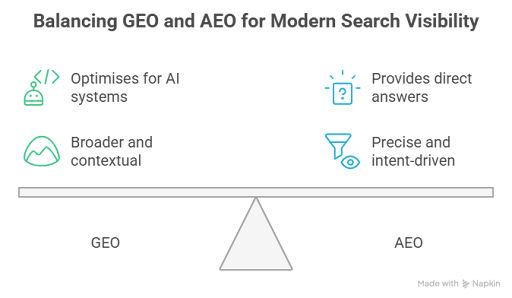
Although GEO and AEO work together, they serve different purposes. GEO focuses on optimising content for AI systems that generate responses by synthesising information from multiple sources. AEO focuses on providing direct answers to specific user questions.
GEO is broader and more contextual. AEO is precise and intent-driven. Together, they form the foundation of modern search visibility.
How GEO and AEO Fit Into Modern SEO
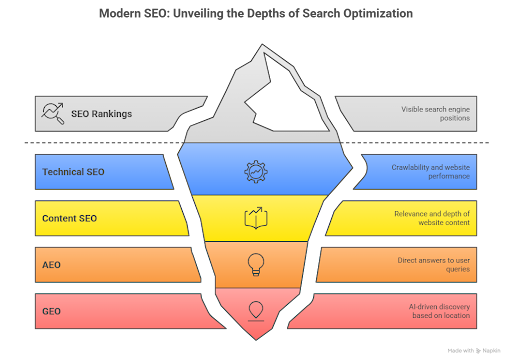
SEO is no longer just about rankings and backlinks. Modern SEO includes:
- Technical SEO for crawlability and performance
- Content SEO for relevance and depth
- AEO for direct answers
- GEO for AI-driven discovery
Ignoring GEO and AEO means optimising for an outdated version of search behaviour.
Best Practices for GEO in Digital Marketing
To optimise for GEO effectively:
- Create in-depth content that fully explains a topic
- Use clear headings and logical content flow
- Focus on entities such as brands, concepts, products, and locations
- Maintain factual accuracy and updated information
- Build strong brand credibility through consistent publishing
AI systems prefer content that demonstrates expertise, authority, and trustworthiness.
Best Practices for AEO in Digital Marketing
To succeed with AEO:
- Identify common user questions in your niche
- Answer the main question clearly within the first few lines
- Use simple language and avoid unnecessary jargon
- Structure content with question-based headings
- Include concise summaries where possible
The goal is clarity, not complexity.
Real World Use Cases of GEO and AEO
E-commerce brands can use GEO to appear in AI-generated product comparisons and buying guides. Service-based businesses can use AEO to answer common customer questions and dominate voice search results. Educational platforms can use both to become trusted knowledge sources for AI systems.
In each case, visibility is no longer limited to search rankings. It extends into AI-driven recommendations and answers
The Future of GEO and AEO
As AI becomes more integrated into search engines, apps, and devices, GEO and AEO will become core digital marketing skills. Businesses that adapt early will gain a long-term competitive advantage.
The future belongs to brands that are easy to understand, easy to trust, and easy for AI systems to reference.
Conclusion
GEO and AEO are not replacements for SEO. They are its evolution. Digital marketers, business owners, and content creators must shift their mindset from ranking pages to answering questions and supporting AI-driven discovery.
If your content helps users and AI systems understand a topic better, you win. If it does not, no amount of optimisation will save it.
0 Comments